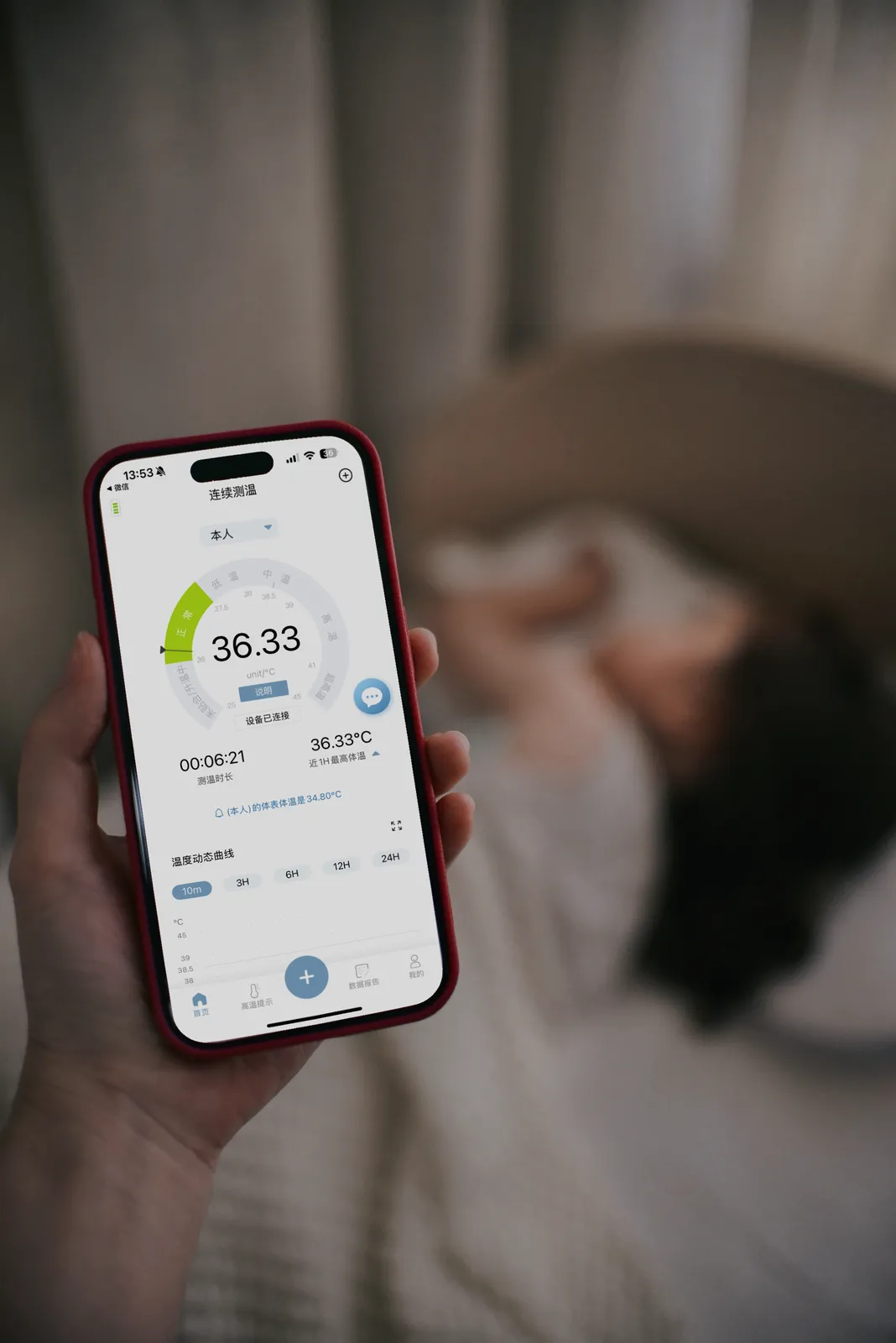
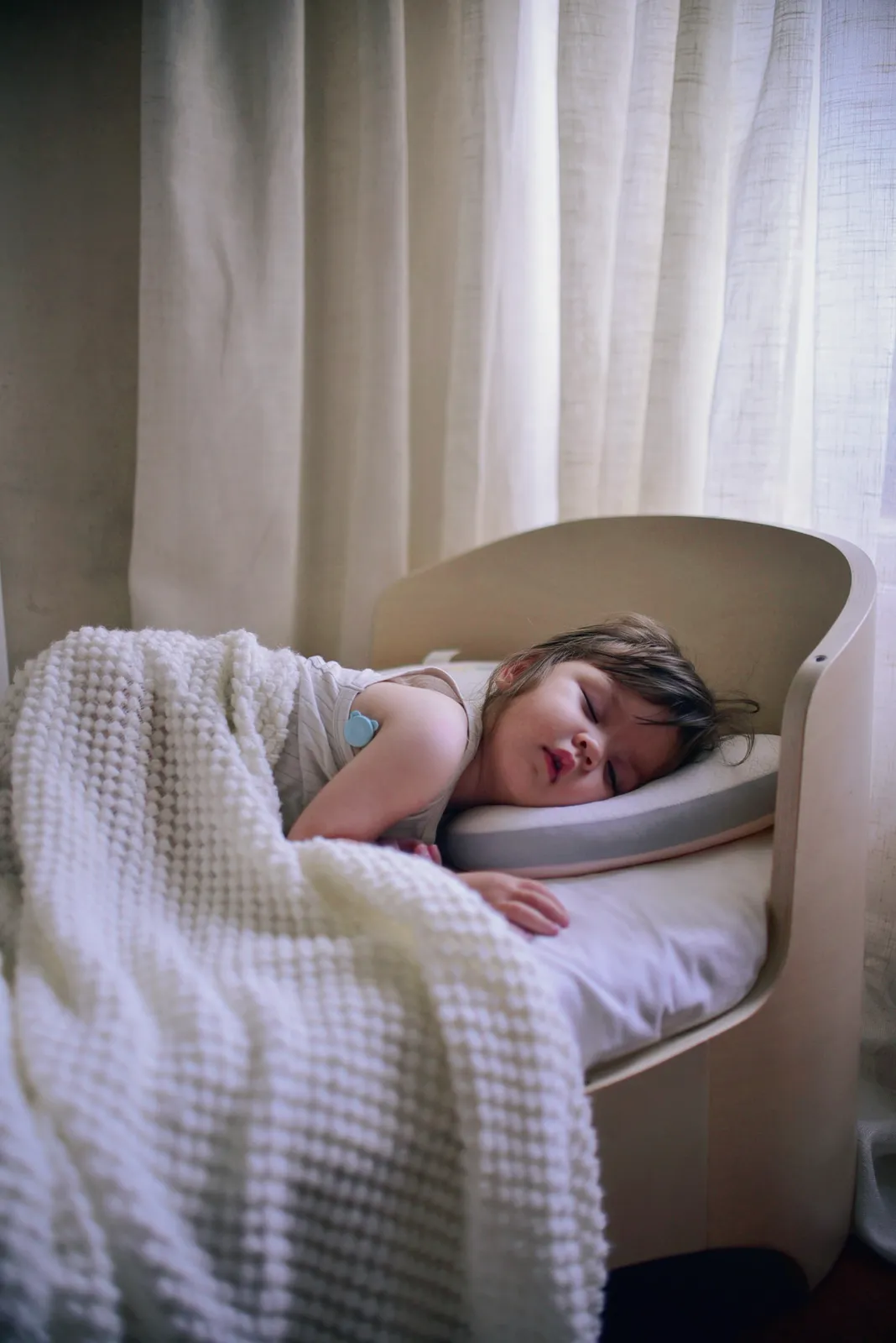
Basal body temperature thermometer for continuous overnight tracking.
Classic basal thermometry needs the same wake time, no movement, and a reading within minutes of waking. P20 replaces that complexity with a continuous overnight curve at 0.01°C resolution.
How overnight BBT tracking works
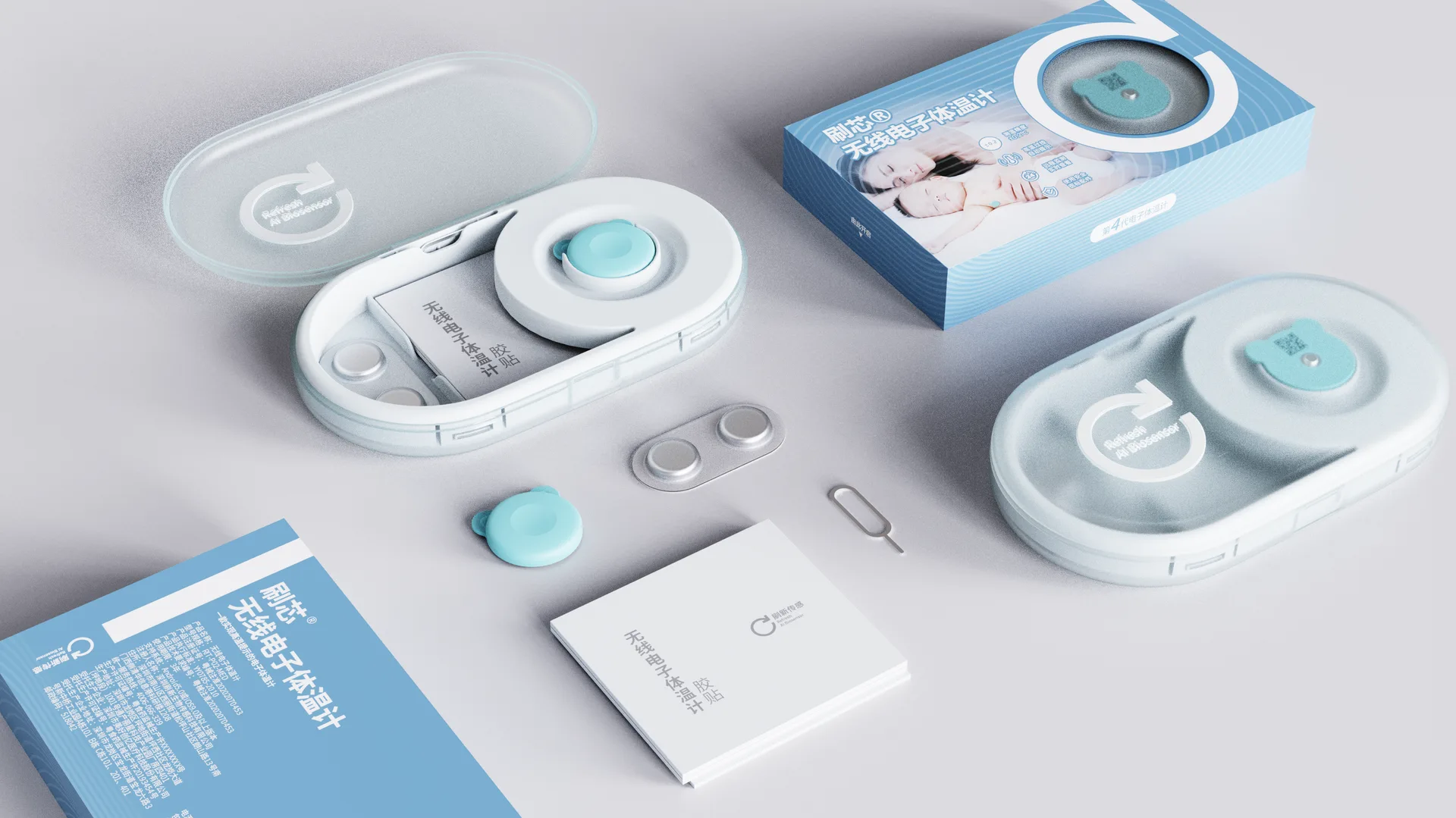
Before bed — stick it on
The sensor weighs 2 grams and holds under the arm on a hypoallergenic medical-grade patch. No strap, no wristband, and skin under the arm stays covered all night — unlike a wrist or finger, which cools whenever a hand slips out from under the duvet.
- 2 g, no strap and nothing to fasten
- Hypoallergenic medical-grade patch
- Same site every night, so nights compare

Through the night — it records without you
One reading every 5 seconds, at 0.01 °C resolution, for as long as you sleep. A single night leaves thousands of readings instead of one number, so the baseline comes from the whole night rather than from one moment in it.
- A reading every 5 seconds
- 0.01 °C resolution
- Up to 7 days of wear per battery

In the morning — nothing to remember
No fixed wake time, no lying still, no reading to take before you get out of bed. Wake at six or at nine and the night is already recorded. A short or broken night shows up in the record as context instead of quietly distorting a single value.
- No fixed wake time
- No stay-still measurement
- A disturbed night is visible, not hidden

Across the cycle — read the shift
The post-ovulatory rise is only a few tenths of a degree, and it means something only against your own preceding nights. Review the full cycle in the app, and export it when you want a clinician to look at the pattern with you.
- Full-cycle view in the companion app
- Exportable history to share
- Read against your own baseline
Reading a full-cycle BBT curve
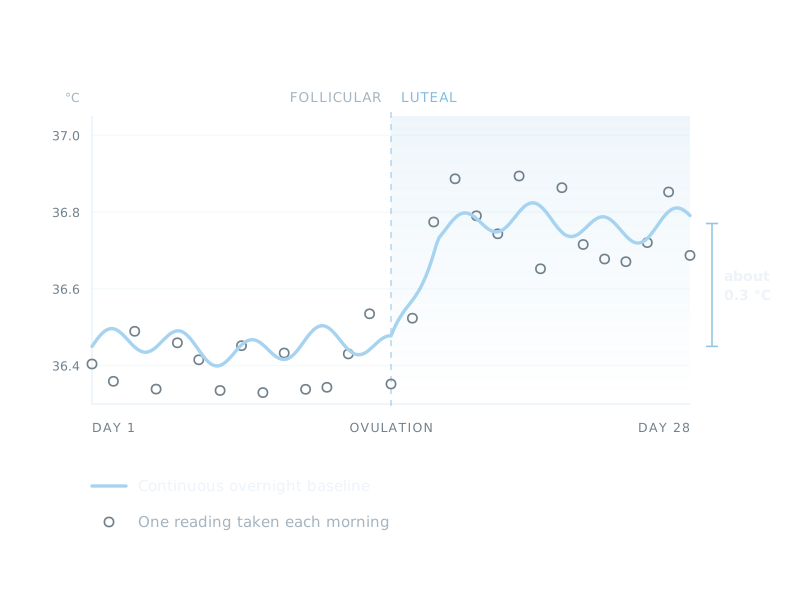
Through the first half of the cycle, resting temperature sits on a low baseline. After ovulation it steps up by roughly 0.3 to 0.5 °C and stays up until the next period. The step is small, which is why it is easier to see in a line built from every night than in one number taken each morning.
- A low baseline through the first half of the cycle
- A step of about 0.3 to 0.5 °C after ovulation
- The higher level holds until the next period
- Single morning readings scatter across the step; a continuous line does not
Continuous BBT tracking vs morning checkups
A single morning reading can be distorted by sleep and timing. Continuous overnight sampling builds a steadier baseline.
| Morning checkup | Continuous BBT | |
|---|---|---|
| Timing | ✗ Must measure at the same wake time | ✓ Records automatically through sleep |
| Data coverage | ✗ One value per day | ✓ Thousands of overnight readings |
| Resolution | △ May blur a subtle shift | ✓ 0.01°C resolution |
| Disturbed sleep | ✗ A short or broken night is invisible in one value | ✓ The whole night is in the record, disturbances included |
| Consistency | △ Site and technique can vary day to day | ✓ Same sensor, same underarm site every night |
One sensor covers both fever monitoring and basal temperature tracking — ask for samples and OEM options.
The specifications behind it
The numbers that decide whether a sensor can see a 0.3°C shift at all.
2 g, stuck on
Two grams, held on by a hypoallergenic medical-grade patch. Nothing to strap on, nothing to dock.
A reading every 5 seconds
Thousands of readings a night instead of one. One restless hour cannot decide the whole night.
0.01 °C resolution
As fine as a dedicated basal thermometer — which matters when the signal you are looking for is a few tenths of a degree.
7 days per battery
One CR1225 coin cell covers a week of continuous wear. Bluetooth carries the record to the app.
Class II, ISO 13485
NMPA-registered Class II medical device, made under ISO 13485, validated to ±0.2 °C against a mercury reference. Every sensor is calibrated before it ships.
One sensor, two uses
The same sensor and app handle fever monitoring and overnight tracking. Fever use gets threshold alerts; cycle use gets a history to review.
Basal body temperature thermometer FAQs
Is a wearable BBT thermometer as accurate as a traditional oral basal thermometer?
P20 offers 0.01°C resolution, at least as fine as dedicated basal thermometers, with the added benefit of continuous overnight sampling rather than one manual reading. Because it doesn't depend on a precise wake-up ritual, it generally produces a more consistent baseline night to night.
Do I need to take my temperature at the exact same time every morning?
No — this is the main advantage of continuous tracking. The sensor records throughout the night automatically, so the app can derive a resting baseline without you needing to wake at a fixed time or take a reading before moving.
What is the difference between 0.01°C resolution and ±0.2°C accuracy?
Resolution is the smallest increment a device can express; accuracy is how closely it agrees with a reference. P20 resolves to 0.01°C and is clinically validated to within ±0.2°C against a mercury thermometer reference. A basal pattern is a relative signal, read against the same person's preceding nights on the same sensor at the same site, so a fixed offset from a reference thermometer largely cancels out of that comparison. Night-to-night consistency is what matters, which is why each sensor is individually calibrated before shipping.
Does a wearable basal body temperature thermometer predict ovulation?
No. The rise in resting temperature described in the literature is driven by progesterone released after ovulation, so it appears once ovulation has already taken place; published wearable studies report most shifts on that day or later. P20 records temperature and builds an overnight curve. It does not predict, confirm or identify ovulation, it is not a contraceptive, and it does not replace an ovulation predictor kit, a clinic assessment or professional medical advice.
I work shifts and sleep at different times. Will the record still be usable?
The sensor records whenever it is worn, so a daytime sleep is captured the same way a night one is. What a temperature pattern needs is consistency of method rather than consistency of clock time: the same sensor, the same underarm placement, and rest periods compared like with like. Irregular rest does make any temperature record harder to read, which is worth saying plainly and worth raising with a clinician.
Can I use the same P20 sensor for BBT tracking and general fever monitoring?
Yes. The same P20 sensor supports both uses. For fever monitoring, the app watches for threshold crossings and sends alerts; for BBT tracking, it records fine-resolution readings throughout the night to build an overnight temperature curve.
Can I export my temperature data to share with a fertility specialist?
Yes, the companion app supports exporting temperature history, so a full cycle's worth of continuous overnight data can be shared or reviewed alongside professional guidance.